
What Is Net Metering and How Does It Work?


Your electricity bill does not have to work against you just because the sun sets. That is essentially what net metering figured out. If you are thinking about going solar, or already installed solar panels on your roof, this one concept changes how you think about the whole investment.
It is not complicated once someone explains it plainly. So here goes.
What Is Net Metering?
Put simply, Net Metering is a billing arrangement between you and your utility company. When your solar panels produce more electricity than your home needs, that extra power flows back into the grid. Your utility logs exactly how much you sent and gives you credit for it.
Later, when your panels are not producing, at night or on overcast days, you draw from the grid as normal. Those credits chip away at what you owe. At the end of your billing cycle, you pay only for whatever remains after the credits are applied. That leftover amount is your net usage, which is exactly where the name comes from.
How Does Net Metering Work? (Step-by-Step)
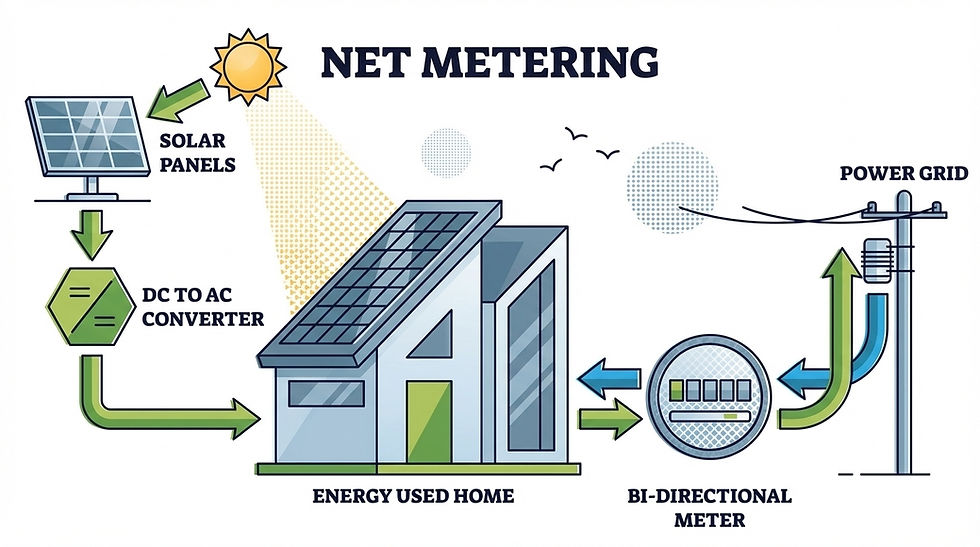
The whole process runs automatically once your system is properly connected. Here is what actually happens at each stage.
Step 1: Solar Panels Generate Electricity
On a clear afternoon, your panels convert sunlight into electricity. That power moves straight into your home first. Whatever your household needs at that moment gets covered immediately, refrigerator, air conditioning, lights, before anything else happens.
Step 2: Excess Power Is Sent to the Grid
Say it is midday, production is strong, and most of the house is empty. The panels are generating more than the house is consuming. That surplus travels back through your electrical connection into the utility grid. Your utility company receives it and records the amount precisely.
Step 3: Bidirectional Meter Tracks Energy Flow
A standard meter only counts what you pull in. A bidirectional meter, part of any properly set up grid-tied solar system, runs in both directions. It tracks what you consume from the grid and what you export to it. Both numbers accumulate throughout the billing period.
Step 4: Net Electricity Usage Appears on Your Bill
When the billing cycle ends, those two numbers get compared: what you drew from the grid minus what you sent back. Whatever remains shows up on your bill. A strong solar month can push that number very low. A stretch of bad weather brings it back up. Either way, you only pay for the gap.
Example: How Net Metering Credits Are Calculated
Numbers make this easier to follow.
Say your panels generate 600 units over a month. Your household uses 450 units. You exported 150 units back to the grid during hours when production ran ahead of consumption.
Your utility credits you for those 150 units. If you pulled 150 units from the grid at night that same month, the credits cancel it out. You pay nothing for that portion. Your bill only covers anything beyond what the credits offset.
Flip it around. Same 600 units generated, but a heat wave pushed consumption to 750 units. You used 150 more than your panels produced. You pay for those 150 units at your normal rate. The rest cost you nothing because the panels already covered it.
Key Components of a Net Metering System
Four things need to be working together for solar panel net metering to function properly.
Your solar panels do the generating.
An inverter converts that output into the form your home runs on.
The bidirectional meter tracks the two-way energy flow and reports it to your utility.
The grid connection is the physical link that lets power move in both directions between your home and the network.
Remove any one of those, and the system does not work as intended. Together, they run largely on their own.
Major Benefits of Net Metering for Homeowners
The financial case for solar is genuinely stronger because of net metering.
Here is the problem it solves. Panels generate the most power around midday when the sun is highest. Most households use the most electricity in the morning and evening when people are actually home. Those two patterns do not line up.
Without net metering, midday surplus goes to waste. With it, that surplus becomes credit applied later when you need it. Your panels keep working for you after dark. That is what pulls the payback timeline in and makes the return on installation real rather than theoretical.
Net Metering vs Gross Metering
These two get mixed up often and the difference matters.
With net metering, your home uses what the panels generate first. Only the surplus goes to the grid, and credits from that export offset what you later draw. With gross metering, everything your panels produce goes directly to the utility. You then buy all your electricity back at the standard retail rate separately.
The issue with gross metering is that utilities typically pay less for exported power than they charge you to buy it back. Net metering cuts out that gap and is almost always the better deal for homeowners.
Final Thoughts
Net metering turns daytime solar production into value that works around the clock. Without it, panels are limited to the hours the sun is actually shining. With it, every unit your system generates goes somewhere useful, either powering your home directly or banking as credit for later.
If solar is on your radar, getting clear on net metering early is one of the more useful steps you can take. The savings show up on your bill every month and compound into something significant over the life of the system.


